Descripción
RouteMaster addresses two serious challenges to audio nirvana: The corruption of ground
integrity by the torturous ground routing in today’s music reproduction systems and the increasing
noise levels on the ground line that have crept up on us over the last decades.
For single ended unbalanced analogue signals with connections between components made for
example by RCA interconnects, the signals are measured between two points, a “Hot” signal is
compared (referenced) to “Ground” giving two points of measurement, the difference between
the two points being what we are interested in. Try measuring a room with a tape when the person
holding the other end won’t hold it exactly where it needs to be or even steadily.
Components connected by balanced e.g. XLR connectors have a “Hot” signal wire with positive
voltages and a “Cold” signal wire with negative voltages both referenced to the third, zero volt
“Ground” wire.
Consider the ground as the horizon, it should show which way is up and be extremely steady and
unwavering, or with the tape analogy it should be steady, unwavering and in the right place.
Go back in time and the ground was usually a very simple affair; the signal was the signal and
ground was ground: The chassis of equipment was metal and was safety grounded by the
incoming power cable giving a direct connection to the ground pin of the power plug. The metal
chassis was also the signal ground, e.g. the barrel of an RCA socket was directly bonded to the
metal chassis. Safety Ground, Chassis Ground and Signal Ground were all one and the same.
With this system, grounds were connected from component to component both by their common
connection to the premises wiring ground via the power cords into the wall and by the
interconnection of signal leads between equipment
An occasional problem with this approach, caused by having simultaneous alternative routes to
ground, is induced current “hum” loops. Hum loops are caused by circling currents; circling
because the connection routes and varying resistances between points are neither uniform nor
methodical. The “circles” required hunting down and breaking to stop the hum. But even with this
occasional problem…… these were simpler days.
Today, things are substantially more complicated: We have to consider and approach a much
more convoluted route map of grounds in our systems where we have not one but three “grounds”
to concern us; they even get their own symbols!
Currently the signal grounds on your various HiFi and AV components may adhere to any of a
number of practices: At the original and most basic level that many equipment makers still adhere
to chassis ground is the same as safety ground is the same as signal ground, but on some
equipment chassis does not equal safety ground and on much equipment signal ground is “lifted”
by x volts from chassis ground by a resistance or other device(s). But here connecting an item
where these three grounds are unified to a component where they are not, will immediately result
in that component having its signal ground “unlifted” and reunited with safety and chassis ground.
And so today, through the interconnection of signal leads to assorted components adhering to
different grounding practices, a rather haphazard, cross confusion of the whole system signal
ground map is created. Ground is an absolutely vital element of the signal, no less so that the
“hot” and any incoherency in the ground is a sonic disaster.
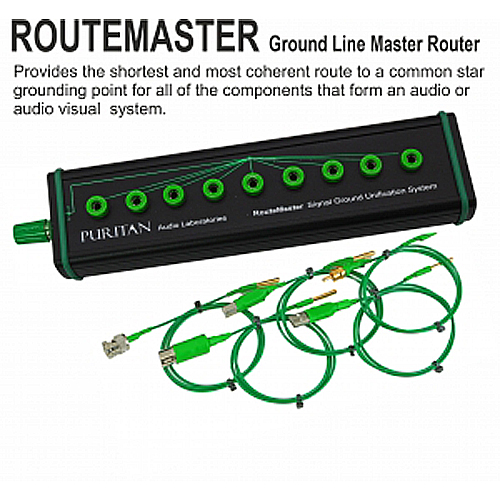
RouteMaster reorganises the tangled web of your system’s grounds in a coherent fashion directly
locating all signal grounds to a single star point. Creating a stable and fixed horizon for all
components to reference to, and navigate from.
RouteMaster accepts grounding reference connections from up to nine system components.
Simply identify a spare input and connect it with the appropriate Ultra Connect cable. For the very
optimum results all RouteMaster UltraConnects should be the same length and hence resistance.
The Star Connection Chamber inside of the RouteMaster, already enhanced for silence by the use
of a unique combination ferroelectric and other materials, can be further silenced and stabilized by
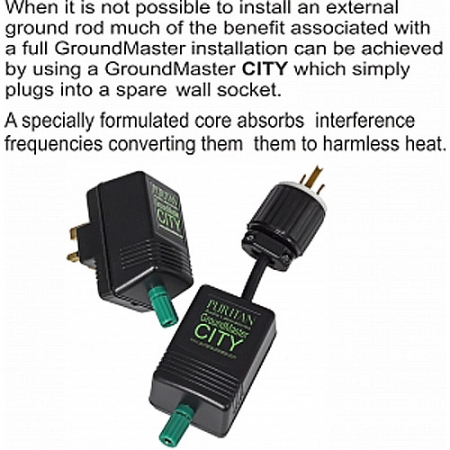
connecting a GroundMaster or GroundMaster City version
If you already have a GroundMaster connected to your system safety earth connection through a
Puritan conditioner or other connection, use a second GroundMaster connected to the same rod.
The two GroundMasters automatically isolate from each other avoiding any circulating currents
Benefit can be gained by treating digital cabling shields (USB, RJ45 etc) independently from
analogue signal grounds. Use a further RouteMaster to gather these connections, the airborne
interferences being absorbed by these screens can then be nullified by routing to earth ground via
an additional GroundMaster or GroundMaster City. This avoids these unwanted interference
energies existing in the shields from where they otherwise are inductive and capacitively coupled
to the digital signal carrying leads, corrupting these signals.
Going even further, noise present on case metalwork can again couple to intended signal paths
and many users find it beneficial to gather all chassis connections to yet another RouteMaster
dealing exclusively with chassis/case noise and treating this independently from the analogue
signal grounds and digital lead shields RouteMasters. Connections are made by loosening a
case screw and inserting a spade terminal Ultra Ground Connect under, gathering all case
connections to a RouteMaster and sinking the noise present to planet earth ground through a
further, separate, GroundMaster or GroundMaster City.
Notes:
Separate GroundMasters or GroundMaster CITYs are required for individual RouteMasters to separate out interference paths
and to avoid ground loops.
When using multiple GroundMasters, only one ground rod is normally required as the GroundMaster isolates one interference
dumping path from another.
The speaker negative/black output from amplifiers is not in all designs at ground potential and for this reason grounding of
speaker outputs is never advised unless you are very certain of your amplifier’s design characteristics as this may cause
damage.